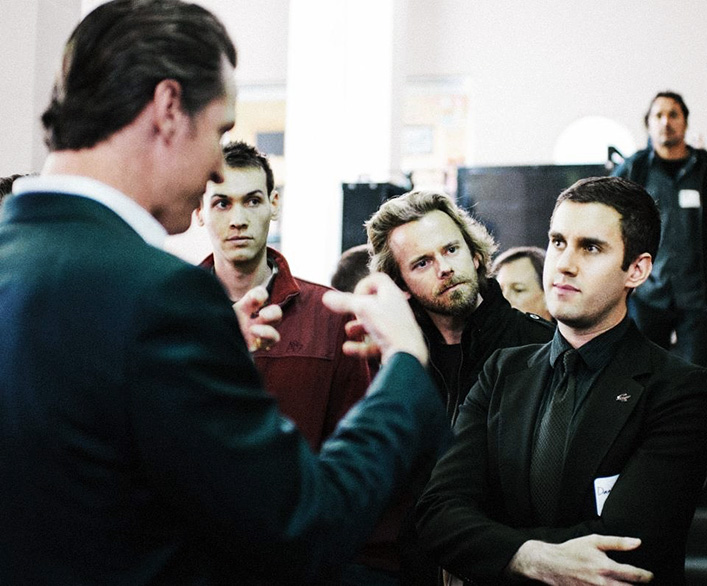
Daniel T Nowinski
Science-trained. People-oriented. Hands-on.
I keep finding my way into complicated systems that need to become useful.
Sometimes that has meant science labs, policy offices, product operations, reporting, analytics, or automated workflows. The setting changes, but the problem often has the same shape: there is a process with history, partial documentation, awkward data, and people who have already built workarounds because they still have jobs to do.
That is usually where I become useful. I like figuring out what connects to what, what has to happen first, where the bottlenecks are, and what would make the whole thing easier for people to use.
I got lucky: a lot of the work I am good at overlaps with what I do for fun (as validated by my Steam library). I like production lines, quest optimization, city-builders, home projects, plant care, and anything else where small choices compound into something great.

ECMC
May 2021 - Current
Senior Business Data & AI Specialist
At ECMC, my work has moved from reporting into data science and now into the practical use of AI inside an organization. The titles changed, but the center of gravity stayed familiar: make the data trustworthy, make the process less painful, and make the output useful to people who have decisions to make.
A lot of my work lives in the unglamorous middle: validating partner data, building logic for metrics, automating repetitive steps, explaining what a number does and does not mean, and helping teams decide when a new tool is actually worth using. AI is part of that work now, but I try to treat it like any other powerful tool: useful when it fits the job, risky when people pretend it is magic.
The Myers-Briggs Company
August 2016 - April 2021
Operations Manager
At The Myers-Briggs Company, I worked on VitaNavis, a digital assessment platform used by colleges and institutions. I was not the person selling the vision from a stage. I was more often the person making sure the thing could survive contact with real users.
That meant configuring offerings, training customers, building digital materials, documenting workflows, and helping institutions understand what they had actually bought. A major part of the work supported a U.S. Department of Education initiative serving minority-serving institutions.
This was where I learned to respect the handoff. A product can be thoughtfully designed and still fail if the implementation is vague, the training is thin, or nobody has translated the tool into the daily reality of the people expected to use it.
Daniel T Nowinski
August 2014 - August 2016
Executive Consultant
My consulting years were not a glamorous independent-practice montage. They were a strange, useful bridge between startup life, policy work, and the more stable professional life I was trying to build.
The work itself was real: federal policy issues, stakeholder outreach, fundraising narratives, higher education, career readiness, and product ideas that needed to survive contact with actual institutions. I helped people prepare arguments, understand the landscape, and avoid saying things that sounded compelling until someone asked the second question.

United States Senate - Office of Senator Barbara Boxer
January 2015 - May 2015
Legislative Intern
Working in the Senate demystified power for me. I answered phones, interacted with constituents, attended briefings and hearings, wrote memos, helped with research, and watched serious people try to get through impossible calendars.
It also taught me that the best idea does not automatically win. A good idea still needs timing, relationships, preparation, and a defensible argument.

GoBeMe
August 2012 - May 2014
Co-Founder, Director of Government Affairs
GoBeMe was a small workforce and education technology startup, which meant everyone had a grand title and at least seven actual jobs. Mine sat somewhere between research, policy, external affairs, and making us sound more real than three people in a room had any right to sound.
I cold-called experts, prepared background materials, built meeting dossiers, shaped our education and workforce story, and helped turn scattered conversations into something partners and funders could evaluate. Eventually the company grew from three people to twenty-one.
It was an early lesson in credibility. Not the fake kind where everything is polished. The practical kind: know the field, know who you are talking to, follow up when you said you would, and make the next conversation easier than the last one.

Vulpe Lab
August 2010 - July 2012
Undergraduate Researcher
In the Vulpe Lab, I worked in ecotoxicogenomics, studying how chemicals and nanomaterials affected Daphnia magna, a freshwater indicator species used in environmental toxicology. The work moved between wet lab and dry lab: culturing, exposures, RNA work, data interpretation, and the small decisions that determine whether an experiment is useful or just expensive.
My work contributed to two peer-reviewed papers; an ACS Nano study on silver nanowire exposure and toxicity, and an Environmental Science & Technology study on flame retardants, gene transcription, metabolites, and lipid response. The lab taught me a practical version of rigor: make the work repeatable, make the assumptions visible, and do not confuse a clean story with a complete one.
University of California, Berkeley
August 2010 - May 2012
Bachelor of Science -
At Berkeley, I studied molecular toxicology: the mechanisms of poisons, drugs, exposures, and biological response. It is a useful field for learning how much can be explained without pretending everything can be known.
A lot of the work was intentionally ambiguous: define the question, respect the evidence, watch for confounders, and revise when the scaffold no longer holds. My favorite detour was an acting class I later returned to as a guest speaker, which turned out to fit the pattern: understanding something and making it intelligible to another person are not the same skill.

Contra Costa College
August 2007 - May 2010
Associate in Science -
Associate in Science -
Associate in Arts -
Associate in Arts -
Associate in Arts -
I took a massive amount of coursework across chemistry, biology, economics, math, public speaking, and social science while preparing to transfer to Berkeley. At times I pushed the unit load too far, partly because I was impatient and partly because I was learning how to stay motivated without waiting for the environment around me to supply the motivation.
That period gave me range, but it also taught me that brute-force ambition has limits. Learning those limits and how to recover from burnout was a valuable lesson.
Detroit Rotary Foundation
September 2024 - June 2027
Trustee and Board Secretary
I serve as a trustee and board secretary of the Detroit Rotary Foundation, which supports youth, community, and international service programs.
The work is a practical kind of stewardship: agendas, minutes, motions, grants, investment accounts, compliance, and the institutional machinery behind doing something decent with donated money. Also, yes, I still have not been to Detroit.

The Rotary Club of Detroit
August 2021 - June 2025
Board Member
I served on the board of the Rotary Club of Detroit despite, somewhat absurdly, not living in Detroit. There is a story there, and it is probably better told in person.
Rotary gave me a practical view of civic organizations: calendars, committees, budgets, traditions, minutes, personalities, and people trying to do something useful with limited time.
Berkeley Free Clinic
January 2011 - May 2011
Volunteer
The Berkeley Free Clinic offers basic medical and dental care, education and vaccination, men's, women's and trans people's STI testing and treatment, anonymous HIV testing, peer counseling, information and referral services, and clean needle services through a collaboration with NEED (Needle Exchange Emergency Distribution).
I of course worked in the lab processing urine, blood, and sputum samples. Not a glorious position, but my lab skills were in high demand.
Environmental Leadership Pathway Program
January 2009 - December 2009
Fellow
As part of the program we were tasked with finding a teacher to sponsor us in their classroom for half of the school year. I taught third grade natural science at Washington Elementary School in Berkeley. It was an amazing and challenging experience that brought to my attention the critical necessity of parental involvement in their children's education.

Center for Science Excellence
September 2007 - May 2010
Fellow
Nominated for membership by my chemistry professor, I was accepted into the Presidential Award winning, Center for Science Excellence (CSE). The program pairs members up with mentors in their STEM field, and provides academic enrichment seminars on Friday afternoons. The seminars prepared me for the many briefings and hearings I would later attend in Congress. It was through this program that I would hear about the Environmental Leadership Pathway Program (ELP).